Updated: April 06, 2026
Every year, patients in their 40s and 50s sit down for a vision correction consultation expecting to leave with a LASIK date on the calendar, and instead learn they are not a good candidate for the procedure. For some, the cornea is too thin. For others, presbyopia has already changed how their eye focuses light, making a corneal procedure the wrong tool for the job.
What many of these patients discover is that a lens-based procedure called refractive lens exchange may be a far better fit for where their vision is right now.

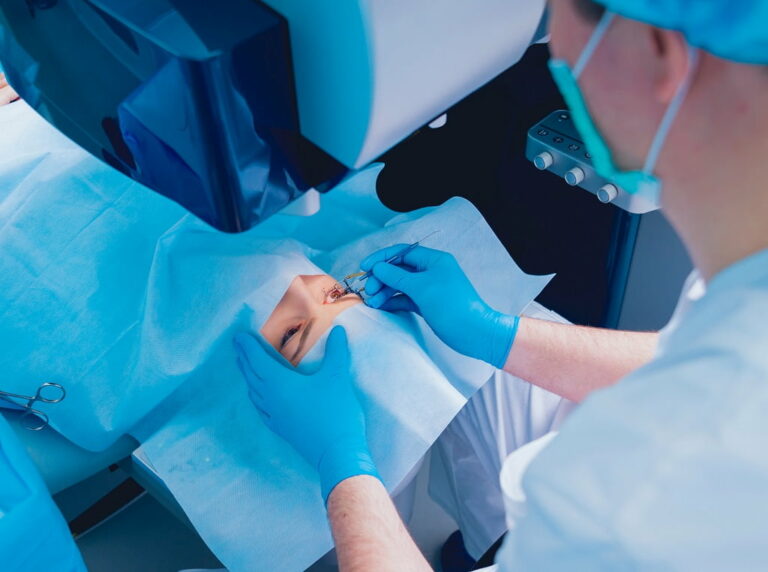
Refractive lens exchange, commonly called RLE, clear lens exchange, or refractive lensectomy, is a surgical procedure that removes the eye’s natural lens and replaces it with a precisely customized artificial intraocular lens (IOL). The IOL is selected based on your specific refractive error, allowing light to focus correctly on the retina and reducing or eliminating your dependence on glasses or contact lenses.
The surgical technique used in RLE is the same proven approach used in cataract surgery, one of the most commonly performed eye procedures in the country. It is performed on an outpatient basis, typically takes less than 20 minutes per eye, and most patients return to normal daily activities within a day or two.
LASIK and SMILE are corneal refractive procedures. They work by reshaping the front surface of the eye so that light bends correctly before it ever reaches the lens. RLE works very differently. Rather than changing the shape of the cornea, it addresses vision issues by changing the eye’s natural lens.
This distinction matters enormously for patients over 40. By the time presbyopia sets in, the natural lens has already started losing its flexibility and clarity. Reshaping the cornea can still correct distance vision, but it cannot reverse the stiffening of the lens or restore the eye’s ability to shift focus between near and far distances. RLE replaces the aging lens entirely, which is why it can achieve results that corneal surgery simply cannot.

Candidacy for RLE is broad, and the procedure is particularly well-suited to patients aged 40 and older. If you have been told you are not a candidate for laser vision correction, or if you are tired of reading glasses and bifocals and want a more permanent fix, RLE deserves a serious look.
Some patients are not good candidates for LASIK or SMILE due to insufficient corneal thickness, corneal irregularities, or prescription levels that fall outside the safe treatment range for laser procedures. RLE has no such limitations tied to corneal anatomy. It can address virtually any degree of myopia, hyperopia, or astigmatism, making it an effective option for patients who have spent years believing surgery was not available to them. It can also correct presbyopia, a common age-related refractive error.
Presbyopia is the age-related condition in which the natural lens gradually hardens and loses its ability to flex and focus. It affects virtually everyone eventually, typically becoming noticeable in the mid-40s. The result is the familiar frustration of holding your phone at arm’s length or reaching for reading glasses you never needed before.
Because presbyopia originates inside the eye, treating it surgically means addressing the lens directly. RLE replaces the stiff natural lens with an IOL designed to support a range of distances, correcting the underlying issue rather than working around it.
The IOL selected for your procedure has a significant impact on your vision outcomes.
At Discover Vision Centers, one standout option is the Light Adjustable Lens, which offers a unique advantage: the prescription can be fine-tuned after the lens is already inside the eye. Using a series of brief UV light treatments, the LAL can be adjusted to optimize distance vision or dialed in for a mild degree of monovision to support both distance and near.
Other IOL options include trifocal lenses designed to provide a full range of vision across near, intermediate, and far distances. Your surgeon will evaluate your lifestyle, visual goals, and eye measurements to recommend the lens best suited to your individual needs.
One of the most meaningful long-term advantages of RLE is that it eliminates the future risk of cataracts in the treated eye. Because the natural lens is completely removed, it cannot cloud over time the way a natural lens eventually does. Patients who choose RLE in their 50s are, in effect, getting ahead of a problem that would otherwise require cataract surgery later in life. You gain the vision correction benefits now and avoid a second surgical procedure down the road.
Recovery from RLE is typically fast. Most patients notice improved vision within 24 hours and are back to their normal routine quickly.
If you select the Light Adjustable Lens as your IOL, you will need to attend a series of adjustment sessions in the weeks following your recovery so that your eye surgeon can customize the lens to meet your specific visual needs and goals. During this time, you’ll be required to wear special UV-protective eyewear to avoid unintended changes to the lens or your vision.

Compared to corneal refractive procedures, RLE also carries a reduced risk of postoperative dry eye, a meaningful benefit for patients who already experience dryness or who work in environments that aggravate it.
The results are permanent. Once your natural lens is replaced, the IOL does not degrade or require updating the way a glasses or contact lens prescription does. For patients who have spent decades managing changing prescriptions and corrective lenses, that stability alone can be a significant quality-of-life improvement.
If you have questions about whether RLE or another vision correction procedure is the right path forward, a consultation with the refractive team at Discover Vision Centers will give you a clear picture of your options based on your specific eye health and goals.
Wondering if refractive lens exchange is the right vision correction option for you? Schedule an appointment at Discover Vision Centers in Kansas City, MO, today!