Updated: June 05, 2026
Cataract surgery itself is one of the most predictable procedures in medicine. What does vary, however, is the decision patients often haven’t fully considered until they’re in the surgeon’s office: which lens to choose. That decision determines whether you’ll need reading glasses for the rest of your life, whether your astigmatism gets corrected at the same time, and how well you see at night, at a computer, or across a restaurant.
For patients in Kansas City exploring their options, here is a breakdown of what separates standard lenses from advanced ones, and what Discover Vision Centers offers across both categories!

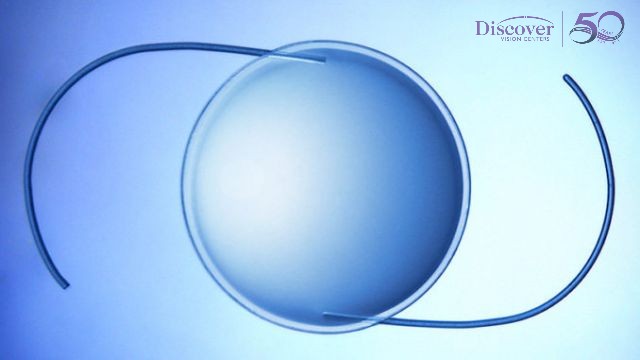
Every cataract surgery follows the same core process: the clouded natural lens is removed and replaced with an artificial intraocular lens, or IOL. The surgery itself takes less than 20 minutes in most cases. But the IOL implanted during that procedure stays in your eye permanently.
It is not something that gets swapped out later if your vision goals change or your lifestyle shifts. That permanence is exactly why the lens selection conversation matters so much before surgery day. The IOL you choose will determine your range of clear vision, whether you still need glasses for certain tasks, and how well your eyes handle conditions like astigmatism or presbyopia going forward.
A standard IOL, also called a monofocal lens, is designed to focus light at a single fixed point.
Most surgeons set this for distance vision, which means patients see well when driving or watching television, but typically still need reading glasses for close work like menus, phone screens, or books. Monofocal lenses have a long track record of reliability and predictable outcomes. They are also the only IOL category traditionally covered by Medicare and most insurance plans, which makes them the default choice for many patients who either prefer not to pay out-of-pocket or have visual needs that a single focal point addresses adequately.
If your primary goal is clear distance vision and you are comfortable with glasses for reading, a standard monofocal lens is a straightforward and proven option.
Advanced or premium IOLs go beyond a single focal point. They are engineered to address a wider set of visual needs, whether that means seeing clearly at near, intermediate, and distance ranges without glasses, correcting astigmatism at the time of surgery, or allowing for post-implant fine-tuning that a standard lens cannot offer.
The category covers several distinct technologies, each designed for a different patient profile. What they share is the ability to reduce or eliminate glasses dependence in ways that a monofocal lens is not built to do. Because they deliver refractive correction beyond what insurance considers medically necessary, premium lenses carry an out-of-pocket cost above what a standard surgery covers.
Discover Vision Centers offers the full range of advanced IOL technology, with surgeons experienced across every category. The right lens depends on your prescription, your eye anatomy, and what you want your vision to be like after surgery.
Astigmatism occurs when the cornea is shaped more like a football than a sphere, with two different curvatures creating two different focal points. Standard monofocal lenses are spherical and cannot account for that irregularity, which means uncorrected astigmatism persists after surgery. A toric IOL is designed with different powers at different axes to match the cornea’s specific curvature, correcting astigmatism and the cataract in a single procedure.

Multifocal and trifocal IOLs are built with concentric rings that split incoming light across multiple focal points, giving the eye the ability to see at near, intermediate, and distance ranges.
At Discover Vision, surgeons use the Alcon PanOptix and Johnson & Johnson Synergy lenses, both of which fall into this category. The Full Focus vision correction program at Discover Vision is built around these premium multifocal implants for patients who want to reduce or eliminate their dependence on bifocals and reading glasses.
The trade-off worth knowing about is that some patients notice halos or starbursts around lights at night, particularly in the months immediately after surgery. For most patients, this diminishes over time as the brain adapts, but it is part of the conversation to have with your surgeon before choosing this category.
Extended depth of focus lenses, specifically the Alcon Vivity and Johnson and Johnson Symfony, work differently. Rather than splitting light into discrete focal zones, EDOF lenses stretch the range of clear focus across a continuous arc from distance through intermediate vision. The result is a wider functional range than a monofocal lens with fewer of the nighttime visual disturbances associated with multifocal designs.
Patients who spend a lot of time on computers, value driving comfort at night, or want reduced glasses dependence without committing to a full multifocal experience often find EDOF lenses a good fit.
The Light Adjustable Lens from RxSight is unlike any other IOL on the market.
It is the only lens that can be precisely adjusted after it has already been implanted in the eye. Once the lens is in place and the eye has healed, a series of brief office visits use a UV light delivery device to reshape the lens material and fine-tune your prescription, including astigmatism correction, to match your actual post-surgical vision.
This matters because no pre-surgical measurement is perfectly predictive of how the eye will heal. The LAL removes that uncertainty by letting the final prescription be dialed in after the fact. It is particularly well-suited for patients who have had prior refractive surgery like LASIK or PRK, where corneal measurements are less straightforward, and for patients who place a high premium on precise, customized results.
Discover Vision has been involved with the LAL since 2008, when Dr. Doane joined the FDA clinical trial.
Medicare and most private insurance plans cover the cost of standard cataract surgery with a monofocal lens.
If you choose to upgrade to a premium IOL, insurance still covers the base surgical cost, but you are responsible for the difference between that covered amount and the cost of the advanced lens. The out-of-pocket cost varies by lens type, with toric IOLs generally at a lower premium than multifocal or LAL options.
Discover Vision offers financing through CareCredit and accepts FSA and HSA funds, which allows patients to use pre-tax dollars toward the upgrade cost. The financial side of this decision is worth planning for early, before surgery is scheduled, so there is time to weigh the options without feeling rushed.

There is no universal answer to which IOL is best. A patient with significant astigmatism who reads constantly and wants freedom from glasses has a different set of priorities than someone who primarily wants clear distance vision and is content wearing readers at home.
Your eye health factors, like macular health, corneal irregularities, and pupil size, also affect which lenses are appropriate. The cataract specialists at Discover Vision take detailed measurements of each eye and discuss your lifestyle and visual goals before making a recommendation. That conversation, not any single feature of a particular lens, is what leads to the right match.
Ready to find out which cataract lens option fits your vision goals? Schedule an appointment at Discover Vision Centers in Kansas City, MO, today!